The One UN Climate Change Learning Partnership offers the course «Introduction to Sustainable Finance», an interactive, practice-oriented course originally developed in 2018 and comprehensively updated in 2021. It covers the basics of sustainable finance with opportunities to go deeper, including instruments, methodologies and frameworks for integrating sustainability into financial decisions, key global initiatives, and sustainable finance regulations. It is designed for participants from governments, academia, the financial sector, businesses and civil society.
The four modules
- Sustainable Finance in Context: two lessons on the role of sustainable finance in delivering global climate and development goals.
- Fundamentals of Sustainable Finance: five interactive lessons on core concepts and the relevance of sustainability to financial decision-makers.
- Sustainable Finance: Regulation and Self-regulation: three lessons analysing the role of regulation and industry initiatives.
- Sustainable Finance Products: six lessons on products such as bonds and loans that can provide capital for the Sustainable Development Goals and the Paris Agreement.
Learning objectives
- Explain the potential contribution of sustainable finance to the SDGs and the goals of the Paris Agreement.
- Explain the core concepts of sustainable finance and the relevance of sustainability for key actors in the financial system.
- Describe the role of regulation and industry initiatives (self-regulation) in shaping sustainable finance.
- Describe sustainable finance products such as bonds and loans.
Certificate
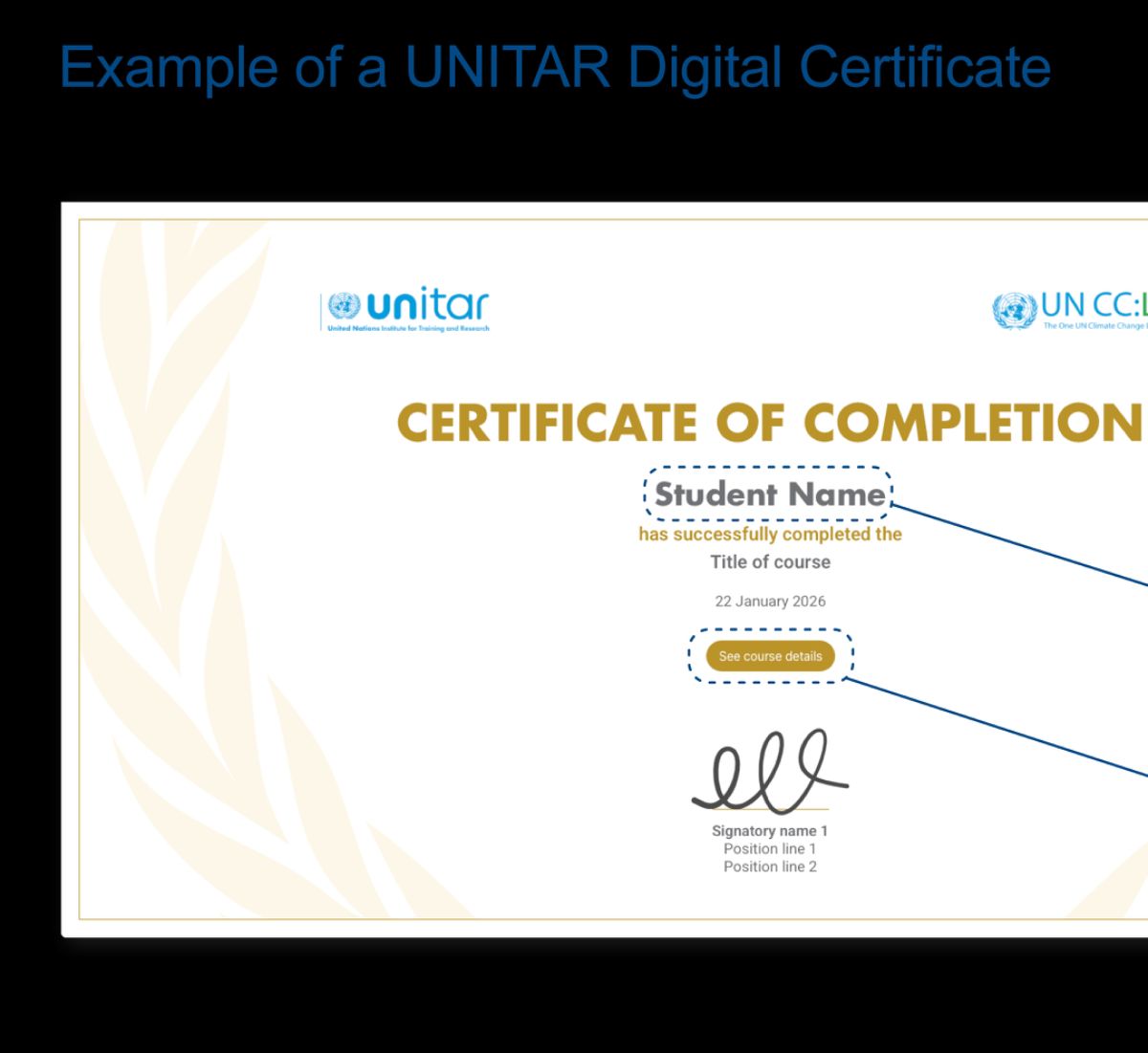
You qualify for the UN digital certificate of completion with a passing grade of 70% or more on all quizzes, with up to 3 attempts per quiz. After passing, the certificate is available upon payment of USD 20.
Special offer
Following COP31, the first 1,000 learners who complete any course get 25% off the certificate with the code COP31, valid until 22 November 2026.
Developers
The course was developed in 2018 by Skandinaviska Enskilda Banken (SEB) and GIZ under their Strategic Alliance, together with the Partnership for Action on Green Economy (PAGE). It was updated in 2021 with funding from the German Federal Ministry for Economic Cooperation and Development (BMZ).