
- Organizing Organization: World Future Council.
- Partners: UNESCO Institute for Lifelong Learning and the Inter-Parliamentary Union.
- Award Theme: Education for Sustainable Development in Cities, 2027.
- Type of Participation: Nominating a policy, law, framework, or institutional measure that has a positive impact on education for sustainable development in cities.
- Eligible Policy Levels: Local, regional, national, and subnational.
- Geographical Scope: International and worldwide. Nominations are welcomed from different parts of the world.
- Program Duration: There is no specified training or participation period. This is an award evaluating existing policies rather than a time-bound training program.
- Funding: The official announcement does not specify a monetary award or financial grant for participants.
- Application Fees: The official announcement does not specify an application fee. Therefore, it is not possible to confirm whether fees apply or to guarantee that the application is free based on the announcement alone.
- Application Procedure: Complete the online nomination form available through the official website. Translated versions of the nomination form are available, including Arabic.
- Language Requirements: The nomination form is available in Arabic, as well as French, German, Hindi, Swahili, Portuguese, and Spanish. However, the announcement does not specify a general language proficiency requirement for nominees.
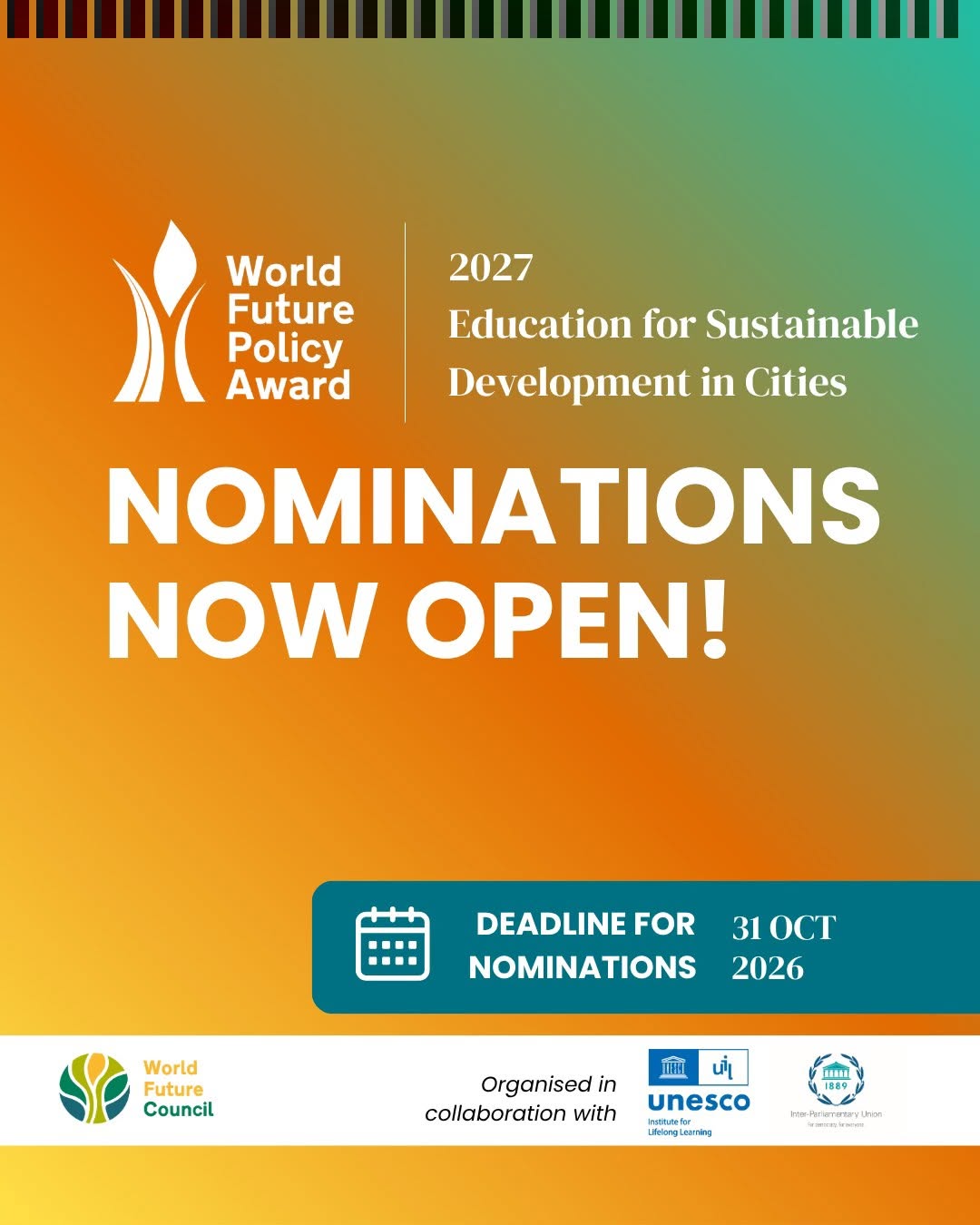
- Application Deadline: October 31, 2026.
- Announcement of Finalists: The finalists are expected to be announced in May or June 2027.
- Award Ceremony: The winning policies are scheduled to be celebrated at a high-level ceremony in cooperation with the UNESCO Institute for Lifelong Learning, alongside the 2027 International Conference on Learning Cities.
- Contact for Inquiries: Samia Kassid, Senior Programme Officer for the award.
- Email: samia.kassid@worldfuturecouncil.org
- Official Application Link:
- https://www.worldfuturecouncil.org/call-for-nominations-wfpa-2027-esd-in-cities/
Publish Date
10/11/2026
Application Deadline
10/13/2026
Opportunity Type
Competitions
Publisher
Foras Khadra
Available Countries
All World, The Arab World, Palestine, Jordan, Syria, Lebanon, Iraq, Saudi Arabia, Kuwait, Qatar, Bahrain, United Arab Emirates, Oman, Yemen, Egypt, Sudan, Libya, Tunisia, Algeria, Morocco, Mauritania, Djibouti, Somalia, Comoros
Description
The World Future Policy Award 2027 is an international initiative organized by the World Future Council in cooperation with the UNESCO Institute for Lifelong Learning and the Inter-Parliamentary Union. Its purpose is to recognize outstanding policies, legislation, and institutional approaches that improve the lives of present and future generations.
The 2027 edition focuses on Education for Sustainable Development in Cities. It aims to recognize policies that help cities and local communities build inclusive and sustainable learning environments, promote lifelong and intergenerational learning, and equip people with the knowledge, skills, and values needed to create fairer, more resilient, and more sustainable communities.
The nomination call targets representatives of international organizations, academic institutions, non-governmental organizations, parliaments, governments, public authorities, Indigenous and local communities, and other stakeholders involved in public policy. Nominated policies may address areas such as urban greening, digital inclusion, and civic participation, particularly participatory budgeting.
The award goes beyond traditional education in schools and universities. It also recognizes policies that integrate learning into everyday life in neighborhoods, local communities, and civic institutions, enabling people of different ages to participate in decisions that shape the future of their cities.
The award seeks to promote successful experiences internationally and inspire policymakers, government authorities, and civil society organizations to adopt innovative solutions that can be adapted to other contexts.
Details
Eligibility Criteria
- The main eligibility criteria concern the nominated policy and its quality and impact, rather than an individual's age, academic degree, or professional experience.
- A. Who Can Submit Nominations?
- According to the official announcement, nominations are welcomed from representatives of:
- International organizations.
- Academic institutions and universities.
- Non-governmental organizations.
- Parliaments.
- Governments.
- Government agencies and public authorities.
- Indigenous and local communities.
- Other stakeholders involved in public policy.
- The announcement does not specify a general requirement concerning the nominee's age, nationality, academic qualifications, or years of professional experience. However, applicants should review the nomination form for any additional requirements relating to the nominating organization.
- B. Criteria for Nominated Policies
- The nominated policy should meet the following criteria:
- Relevance to community-based learning: It should address at least one of the specified focus areas within a community-based learning framework.
- Urban greening: Where relevant, the policy should contribute to environmental sustainability and the improvement of urban environments.
- Digital inclusion: Where relevant, the policy should support strategies that expand digital access and reduce exclusion from digital technologies and services.
- Civic participation: Where relevant, the policy should strengthen public participation and civic engagement, with particular attention to participatory budgeting.
- Alignment with the World Future Council's Seven Principles for Future-Just Lawmaking: The policy should align with the principles used by the organization to assess policies.
- Diversity and inclusion: The policy should reflect an inclusive approach that considers the needs of different groups and the perspectives of Indigenous and local communities.
- Replicability and applicability: The experience should offer lessons that can be adapted and applied in comparable contexts.
- Transformation and innovation: The policy should demonstrate the potential to create positive change and offer innovative and inspiring solutions.
- Recognition of Indigenous and local communities: The organizers particularly encourage nominations that involve these communities and reflect their cultural, social, and legal perspectives, as well as their worldviews.
- Important: An initiative that is merely educational or environmental may not be sufficient. The nomination should concern a policy, framework, or institutional measure relevant to the award's theme and consistent with its published assessment criteria.
Opportunity Benefits
- The award's stated benefits focus on recognizing outstanding policies, sharing successful approaches, and encouraging their adoption internationally. It is not primarily a scholarship or employment opportunity for individuals.
- International recognition: An opportunity to recognize outstanding policies that have a positive impact on education for sustainable development in cities.
- Greater visibility and outreach: Successful policies can gain visibility among policymakers, civil society organizations, and the wider public.
- Inspiration for decision-makers: The award helps showcase practical solutions that can support governments, municipalities, and institutions in developing more sustainable and inclusive policies.
- Transferability of successful practices: It provides an opportunity to highlight policies that may be adapted and implemented in other cities and communities.
- Contribution to the Sustainable Development Goals: The award highlights policies that support Sustainable Development Goal 4, Quality Education, and Sustainable Development Goal 11, Sustainable Cities and Communities.
- Recognition at an international event: The winning policies are scheduled to be celebrated at a high-level ceremony in cooperation with the UNESCO Institute for Lifelong Learning, alongside the 2027 International Conference on Learning Cities.
- Enhanced institutional profile: International recognition may help increase interest in a policy and highlight its impact to relevant stakeholders. However, this does not guarantee additional funding or future partnerships.
- Institutional networking opportunities: Participation in the award may provide opportunities to showcase successful practices to organizations working in education, lifelong learning, and sustainable urban policy. However, the announcement does not guarantee a specific networking program, travel funding, or accommodation.
- Benefits Not Confirmed by the Official Announcement
- To avoid presenting unverified information as fact, the following should not be considered guaranteed benefits:
- A monetary grant or a cash prize of a specified amount.
- Free flight tickets.
- Free accommodation.
- A salary or financial allowance for participants.
- A training certificate or academic qualification.
- Coverage of participation expenses.
- Guaranteed employment or training opportunities.
- The official announcement explains the award's objectives, nomination procedures, and timeline but does not provide detailed confirmation of these benefits.