
- Study level: Master’s degree (graduate level only).
- Program duration: 2024–2034 as part of the partnership between McGill University and the Mastercard Foundation.
- Number of scholarships: 35 scholarships are available each year across 13 graduate programs.
- Host institution: McGill University, Canada.
- Target fields:
- Nutrition.
- Public health.
- Public policy.
- Sustainable agriculture.
- Application process:
- Check eligibility requirements.
- Register for and attend an information session to receive the Mastercard Foundation Scholars Program application form link.
- Complete the Mastercard Foundation Scholars Program application form.
- After passing the pre-screening stage, submit additional documents as requested.
- Successfully pre-screened applicants will receive a fee waiver and instructions on how to apply for admission to McGill University.
- Applicants must apply to the Mastercard Foundation Scholars Program first. Only applicants who successfully pass the pre-screening stage will be invited to apply for their chosen academic program at McGill University.
- Applications submitted outside the official application process will not be accepted.
- Applicants who previously applied to McGill University and deferred their admission offer must reapply through the scholarship process.
- Language requirements: Applicants must meet the language requirements of their chosen graduate program at McGill University.
- The scholarship does not support undergraduate studies; it is only available for graduate-level programs.
Publish Date
7/26/2026
Application Deadline
Not Specified
Opportunity Type
Scholarships
Publisher
Foras Khadra
Available Countries
Egypt, Sudan, Libya, Tunisia, Algeria, Morocco, Mauritania, Djibouti, Somalia, Comoros
Description
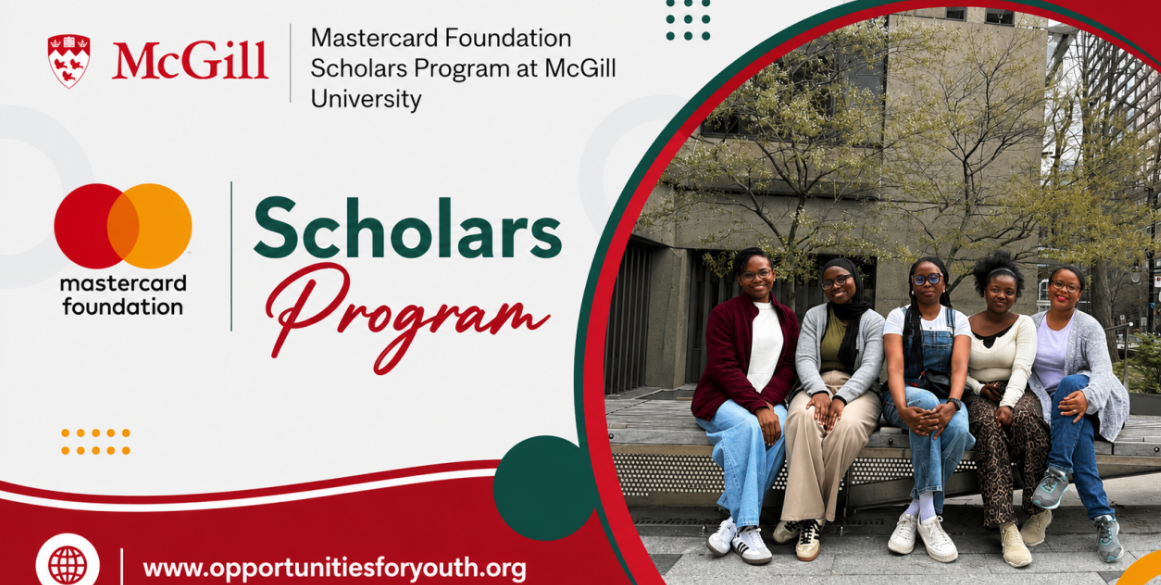
The Mastercard Foundation Scholars Program at McGill University is one of the largest scholarship and leadership initiatives of its kind in Africa. The program aims to strengthen the higher education ecosystem by promoting inclusion and accessibility, encouraging innovation in teaching and learning, supporting research, and fostering collaboration across key sectors and stakeholders.
From 2024 to 2034, the Mastercard Foundation Scholars Program at McGill University will support talented leaders and changemakers from across Africa who are pursuing master’s degrees and who aspire to improve and transform the fields of nutrition, public health, public policy, and sustainable agriculture across the African continent.
The program targets outstanding graduate-level students who have the potential to create positive social impact. Scholars will receive comprehensive support to pursue their studies at McGill University and contribute to the development of their communities.
Details
Eligibility Criteria
- Applicants must be citizens or residents of an African country.
- Applicants must be applying for a master’s degree program.
- Must meet the general graduate admission requirements of McGill University.
- Must meet the academic requirements of the selected graduate program.
- Previous academic background or relevant experience may be required depending on the chosen program.
- Applicants must not have started or completed a previous master’s degree.
- Must meet the required age criteria.
- Must demonstrate strong motivation for applying to the scholarship.
- Must show commitment to creating positive social impact.
- Priority will be given to:
- Women.
- People living with disabilities.
- Refugees.
- Internally displaced people.
- Attendance at an information session is required to receive the application form.
- Applicants who do not meet McGill University’s graduate admission requirements are not eligible.
Opportunity Benefits
- Full coverage of international student tuition fees at McGill University.
- Coverage of all costs related to studying at the university.
- Pre-arrival and immigration support.
- On-campus accommodation.
- Personal monthly living stipend.
- Academic tools and resources.
- Application fee waiver after successfully passing the pre-screening stage.
- Opportunity to study at McGill University in Canada.
- Access to a global network of leaders and changemakers.
- Development of leadership and professional skills.
- Opportunity to gain experience in research, development, and social impact fields.
- Opportunity to contribute to the improvement of important sectors in Africa, including public health, sustainable agriculture, and public policy.
- Comprehensive support to help talented students achieve their academic and community goals.